

Your Company Has a Green Policy. Does It Cover E-Waste?
Executive Summary:
While most corporate environmental guidelines focus heavily on office paper reduction and plastic recycling, a standard company green policy e-waste strategy is often completely non-existent. This critical oversight leaves Philippine businesses highly exposed to severe regulatory penalties under the SEC’s PFRS S2 climate disclosures and catastrophic data privacy breaches under RA 10173. Expanding your internal green policies to mandate certified IT Asset Disposition (ITAD) bridges this compliance gap, protects your data infrastructure, and provides verifiable carbon avoidance metrics for your board.
The Superficial Limits of Modern Green Policies
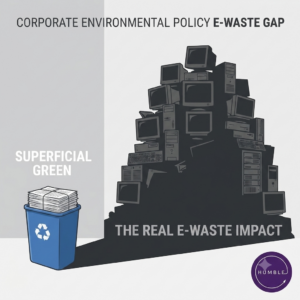
Take a close look at your organization’s current internal environmental manual. More likely than not, your guidelines are packed with rules regarding double-sided document printing, energy-efficient office air conditioning settings, and the elimination of single-use plastics in the pantry. While these small operational changes are certainly commendable, they represent a drop in the bucket compared to your actual industrial footprint.
The single most toxic waste stream your business generates is completely absent from your handbook. When your company green policy ignores e-waste, your entire sustainability framework operates on a deeply flawed foundation.
The Massive Footprint of Corporate Technology
Enterprise technology lifecycles move at an incredibly rapid pace to keep up with modern software requirements. Every hardware refresh cycle sends hundreds of depreciated corporate laptops, network switches, and computer monitors into retirement.
These electronic devices are not harmless pieces of plastic; they are complex assemblies filled with highly hazardous materials. If your internal guidelines do not explicitly dictate how this hardware is decommissioned, your company faces massive, unmonitored ecological and regulatory liabilities.
The Crushing Weight of PFRS S2 Value Chain Disclosures
The regulatory environment in the Philippines no longer tolerates gaps in your environmental bookkeeping. The Securities and Exchange Commission (SEC) actively enforces the PFRS S2 framework, making comprehensive climate-related disclosures mandatory for major enterprises.
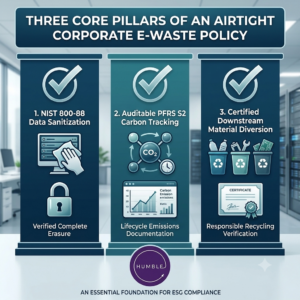
Under these strict international standards, your organization must supply hard, mathematical data regarding your Scope 3 value chain emissions. You can no longer hide behind vague marketing promises or unverified green claims.
If your procurement team continues to offload retired technology through uncertified local scrap auctions, you create a permanent data vacuum in your corporate reporting. Certified ITAD processing converts your physical asset clearance into verified carbon avoidance metrics that satisfy external auditors completely.
The Catastrophic Cybersecurity Overlap
A weak environmental policy does more than damage your local ecosystem—it actively compromises your central data security. Every single hard drive, server blade, and employee workstation scheduled for disposal contains sensitive corporate data assets.
Under the Data Privacy Act of 2012 (RA 10173), the National Privacy Commission holds your board personally liable for this data until its certified, permanent destruction. Handing un-wiped storage media over to traditional junkshops or unverified brokers invites a devastating data breach.
A modernized company green policy handles e-waste through a dual-lens approach, ensuring that military-grade data sanitization occurs before any physical recycling takes place. True ITAD specialists apply the global NIST 800-88 standard to overwrite every digital sector, providing a serialized Certificate of Data Destruction for your compliance records.
CFO Alignment: Transforming Waste into Capital
Upgrading your environmental guidelines is also a highly rational financial strategy that appeals directly to your procurement directors and CFO. Technology assets depreciate in value at an alarming rate every week they sit gathering dust in crowded office stockrooms.
A formalized disposition framework mandates the immediate processing of retired hardware while secondary markets still demand it. A certified partner sanitizes, refurbishes, and remarkets your working devices back into global secondary channels.
This circular economy model injects recovered working capital directly back into your technology budgets, allowing you to offset the rising cost of your next major hardware upgrade. It is a brilliant financial play that drives major environmental benefits simultaneously.
Upgrade Your Strategy with Humble Sustainability
Relying on outdated environmental guidelines exposes your business to severe data privacy liabilities and major regulatory penalties. You need a professional, elite asset partner that understands how to bridge the gap between world-class security and auditable environmental reporting.
Humble Sustainability specializes in managing high-volume enterprise liquidation across the Philippines seamlessly. We handle the complex technical reverse logistics, execute verified data destruction, and provide your ESG team with audit-ready carbon metrics automatically.
Stop letting an incomplete environmental policy expose your business to severe compliance risks and capital loss. If you are ready to secure your sensitive corporate data and align your operations with modern SEC mandates, we are here to help. Fill out the contact form below to schedule an expert asset evaluation and secure policy consultation with Humble Sustainability today.
Related Reading:
Ready to learn what specific questions your procurement team must ask external vendors to guarantee absolute data safety? Read: What to Ask an ITAD Provider Before You Hand Over Your Hardware.